McCandless Runs for Mayor While Crackerneck Creek Bleeds Independence Dry

Bass Pro, Big Promises, and a Bad Bust
The Family Name Behind the Project
How Will the City Come Out When the Developer Is Also “Daddy”?
Legal Fine Print vs. Public Outrage
The Optics That Won’t Go Away
For fed‑up Independence residents, Crackerneck Creek isn’t just a bad deal—it’s the pothole that never gets filled, a giant crater in the city’s checkbook that reappears every time City Hall talks about budget cuts, staff layoffs, shabby parks, and crumbling roads. And yet the city continues to ask for tax hikes. Would the latest 55‑million‑dollar general obligation bond even be on the table if the candidate’s family hadn’t helped milk the city dry on a doomed TIF that never came close to its glittering promises? While neighbors tighten their belts, Independence is still writing checks for a decades‑old “big idea” that turned into a long‑term IOU.
Now comes a mayoral hopeful whose father‑in‑law is tied to the very project that put taxpayers on the hook, and suddenly every line about “responsible development” sounds less like a pledge and more like a loyalty test: will she take on the dealmakers even when they share her family tree at the family dinner table? In a town still bleeding from Crackerneck’s broken promises, that’s the powder‑keg question hanging over the ballot—and voters will decide whether to light the fuse. Do they want a privileged insider who cost the city millions to be their next Mayor?
City Wallet on Life Support
Crackerneck Creek debt continues to devour the city’s general fund. The city will be paying for the failed Crackerneck Creek TIF largely out of its own regular revenues—through “annual appropriation” and other legally available funds—long after the TIF itself stops generating money. In practical terms, that means taxpayers, not the project, will cover the remaining tens of millions in bond payments through 2051. Today, the debt bill to the Independence taxpayer is somewhere over 70 million dollars. And it is not a rainbow picture.
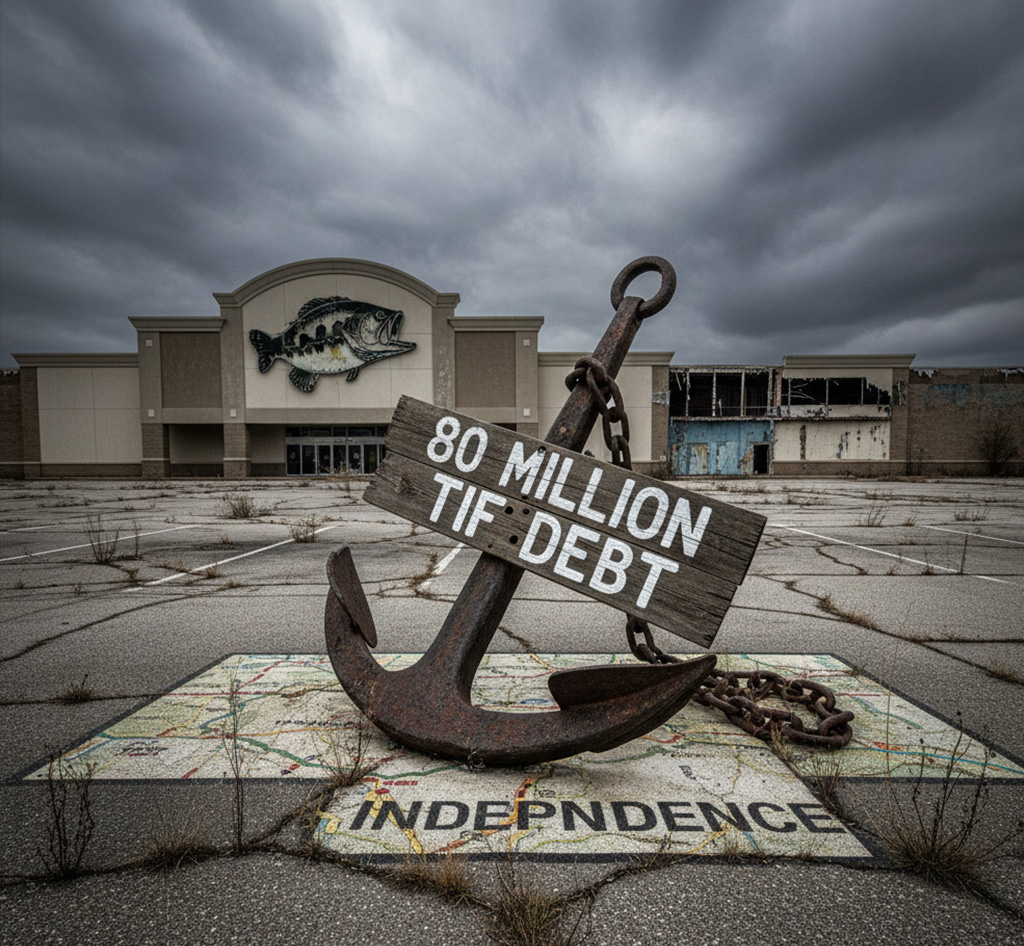
Just over the last year, McCandless voted to close Adventure Oasis Water Park (yep, no pool kiddo’s) and to shut down most of the bus service for the City of Independence. Would those cuts have been necessary if the Bass Pro anchor weren’t still hanging around the city’s neck? But let’s look farther back.
Here is a list of what the city has lost over the last 20 years.
Direct cash subsidies
The city had to pour nearly $18 million from its general, utility, and sales tax funds into Crackerneck bond payments between 2011 and 2017 alone. From 2017 on they city was just paying interest payments.
Long‑term debt burden
Independence still faces roughly $80 million in Crackerneck bond principal stretching out to 2051, locking future councils into decades of payments. Few future options when you have bad credit card debt.
Pressure on the general fund
Because pledged project revenues are not enough, the bonds now rely on “annually appropriated legally available funds,” meaning the general fund and other citywide revenues must backfill shortfalls—squeezing money that could go to parks, roads, and sidewalks.
Service cuts and layoffs
City disclosures describe “substantial hardship,” including employee layoffs, furlough days, wage freezes, and service and program reductions, directly tied to covering Crackerneck shortfalls.
Lost opportunity for other projects
Money and debt capacity tied up in Crackerneck have limited the city’s ability to finance other economic development or capital projects over the same period—like roads, bridges, and parks. Some bridges have been out of service for years. A clear example of the failed TiF.
Weaker budget flexibility and credit stress
Credit analysts note that covering Crackerneck shortfalls from operations has strained budget flexibility and added to already high fixed costs, contributing to rating pressure for the city.
Underperforming tax base on prime land
A 192‑acre site that was supposed to host around 450,000 square feet of vibrant retail has delivered far less, meaning lost sales and property tax potential compared with what was promised.
Extended risk beyond the TIF life
Refinancing pushed debt payments far beyond 2027, when TIF revenues end, ensuring that future shortfalls will hit the city’s core budget, not the project’s own tax increment.
Public trust and political fallout
The failure and the legal fight with the developer have fueled lawsuits, public anger, and deep skepticism about any new incentive deal, making future partnerships harder and more controversial.
Those are just some of the cost of this failed TiF.
Crackerneck Creek TIF Failure: A Comprehensive Analysis for Independence, Missouri
The Falls at Crackerneck Creek represents one of Independence’s most significant and costly economic development failures, with taxpayers bearing the burden of a project that has dramatically underperformed its original projections for nearly two decades.wccwatch+1
Project Origins and Developers
The Crackerneck Creek Tax Increment Financing Plan was approved by the City of Independence in October 2004. The development was led by Crackerneck Creek LLC, whose principals include Byron Constance, an Independence attorney, and J Stewart. Constance’s law firm, Stewart Cook Constance Minton, is located at 501 W Lexington Ave in Independence.indepmo+5
The original 2004 plan envisioned transforming a 192-acre area southwest of interstates 70 and 470 into a 450,000 square foot commercial retail center anchored by Bass Pro Shops, with a minimum of 300,000 square feet of additional retail space and a hotel. The total project was estimated at $171.3 million, with TIF financing providing $73.6 million.independence.

Original Bond Amounts
- Between 2005 and 2009, the Missouri Development Finance Board issued $89,570,000 in bonds (later reported as $89.6 million) to finance the Crackerneck Creek project, covering development costs, reserves, capitalized interest, and costs of issuance. This bonded debt was backed by the City of Independence through annual appropriations.bizjournals+2
The bonds were issued in multiple series:
- Series 2005 bonds (various tranches)
- Series 2006B: $14,030,000 (taxable)
- Series 2009 bonds
- Series 2013A: $14,005,000 (taxable refunding)
- Series 2013B: $10,835,000 (refunding)
- Series 2015C: $47,060,000 (refunding)independence.
novusagenda+2
Current Outstanding Debt (2024-2025)
The city has refinanced the Crackerneck Creek bonds multiple times—most recently in 2021—in attempts to better align debt service with anticipated (but inadequate) revenue.bakertilly+3
In 2021, Independence issued Series 2021 bonds totaling $38,770,000 through the Missouri Development Finance Board to refund three outstanding series:
- Series 2006B: $14,030,000 (fully refunded)
- Series 2013A: $13,905,000 (fully refunded)
- Series 2013B: $10,835,000 (fully refunded)independence.
novusagenda+1
As of 2024, the total outstanding Crackerneck Creek debt stands at approximately $85.8 million, consisting of:
- Series 2015C Bonds: $47,060,000 (not refunded in 2021)
- Series 2021 Bonds: $38,770,000 (issued to refund earlier series)independence.
novusagenda+2
According to the most recent court filings, the city reports $80.2 million in bond principal remaining to be paid through 2051. This represents a slight reduction from the 2021 refinancing total, reflecting payments made since then. The bonds carry a BBB+ rating from S&P Global Ratings.i-dealprospectus+3
The Development's Spectacular Failure
The project has failed catastrophically to meet its original projections. When Bass Pro Shops opened in 2008, developers predicted the project could attract as many as 50 additional tenants. Instead:bizjournals
- The development added only six tenants between 2009 and 2017bizjournals
- As of 2021, the project included only the Bass Pro Store, a hotel, approximately 94,732 square feet of retail, and approximately 28,266 square feet of restaurant uses—far short of the promised 450,000 square feetindependence.novusagenda
- One major tenant, Los Cabos Mexican Grill and Cantina, closed in October 2024facebook+1
- A 167-room Stoney Creek Hotel opened in 2014, and The Adirondack, a 275-apartment complex, opened in 2024bizjournals
- At least 11.3 acres of land remain listed for lease or sale as of 2025bizjournals
- Current retail tenants total only approximately 109,432 square feet—barely one-third of the promised 300,000 square feetbizjournals
The project “failed to attract much interest from tenants and the parkland complex was never built,” according to contemporary accounts. By 2007, the city had already terminated Crackerneck Creek LLC as the TIF plan’s developer of record due to failure to meet development obligations, though negotiations continued.instagram+1
City Taxpayer Bailout: Over $17 Million
Because the development generated far less revenue than projected, the City of Independence has been forced to subsidize bond payments from its general fund, utility funds, and sales tax funds. Between 2011 and 2017, Independence taxpayers covered more than $17 million in debt service shortfalls:bakertilly+1
Breakdown of City Contributions (2011-2017):
- General Fund: $13,951,364
- Utility Funds: $1,682,643
- Sales Tax Funds: $2,258,751
- Total: $17,892,758independence.
novusagenda+1
The annual appropriations broke down as follows:
- Fiscal Year 2011: $3,566,752
- Fiscal Year 2012: $4,142,859
- Fiscal Year 2013: $4,792,478
- Fiscal Year 2014: $1,732,384
- Fiscal Year 2015: $1,390,419
- Fiscal Year 2016: $1,479,373
- Fiscal Year 2017: $788,493 independence.novusagenda
These shortfalls caused “substantial hardship” for the city, forcing employee layoffs, furlough days, wage freezes, and service and program reductions. The city acknowledges it will likely need to continue making general fund appropriations until all Project Bonds are paid—potentially through 2051.i-dealprospectus+3
Ongoing Legal Battle
The failure has spawned bitter litigation. In January 2024, Crackerneck Creek LLC filed a lawsuit against the City of Independence, claiming the city wrongfully withheld $2.6 million in TIF savings that the developer says it was owed. The developer seeks $6.9 million in total payments, plus additional costs and expenses.independencemo+1
Developer’s Claims:
- The developer completed $5.5 million in site improvements and roadways, but Independence paid only $2.9 million
- The city claimed it had “no funds available” for site improvements for Cheddar’s Scratch Kitchen (opened 2011) and said TIF proceeds for Stoney Creek Hotel were “no longer available”
- The developer also claims Independence failed to reimburse it for $484,603 in public improvement projects completed outside the TIF budget at the city’s request
- Crackerneck Creek argues the bond shortfalls resulted from the city’s withholding of savings, Bass Pro’s underperformance, and the 2007 financial crisis—not the developer’s failuresbizjournals
City's Counterclaims:
- Independence terminated Crackerneck Creek LLC as the developer in June 2007 due to failure to meet retail development obligations
- The developer was contractually obligated to build 150,000 square feet of retail by December 2006, but has never achieved even the total 300,000 square foot requirement
- The city argues there are no savings because all TIF revenue must go to bond payments, with the developer entitled only to leftover funds (of which there are none)
- The city’s damages from the developer’s breaches “far surpassed” the developer’s claimed damages, with over $17 million in shortfalls between 2011-2017
- Because the city refinanced bonds in 2021 and pushed repayment beyond 2027 (when TIF revenue collection expires), even future retail development won’t generate TIF revenue to cover bonds, increasing the city’s long-term exposurebizjournals
Long-Term Financial Impact
The city has refinanced the Crackerneck Creek bonds multiple times—most recently in 2021—in attempts to better align debt service with anticipated (but inadequate) revenue.bakertilly+3
The Crackerneck Creek failure continues to burden Independence taxpayers:
- TIF revenue collection expires in 2027, but bonds don’t mature until 2051—meaning 24 years of debt payments without dedicated TIF revenueindepmobonds+2
- The 2021 refinancing, while providing some interest savings, extended the city’s obligation decades beyond the TIF collection periodbondlink-cdn+1
- Even with significant future development within the TIF district, the revenue would not flow to bond payments due to the TIF expiration in 2027bizjournals
- Annual appropriations for Crackerneck Creek debt service in recent years have totaled approximately $7.1 million per year (combining Series 2015C, 2015D, and 2021A)independence.novusagenda
- The project carries a BBB+ rating—two notches below the city’s ‘A’ issuer credit rating—reflecting the substantial risk and the city’s need for ongoing general fund supportspglobal+2
The Crackerneck Creek debacle stands as a cautionary tale of over-optimistic TIF projections, inadequate developer accountability, and the long-term fiscal consequences borne by taxpayers when economic development projects fail to deliver on their promises. With approximately $80 million in debt remaining through 2051 and ongoing litigation with the developer, Independence residents will be paying for this failure for decades to come.bizjournals